- All Products
- All Products
- Attachment Control for Odoo - OneDrive Connector

Attachment Control for Odoo - OneDrive Connector
https://spre.es/shop/attachment-control-for-odoo-onedrive-connector-74 https://spre.es/web/image/product.template/74/image_1920?unique=6eda986Attachment Control - OneDrive
Add OneDrive as a storage backend for Attachment Control so routing, audit, move, storage archive and restore workflows can work with Microsoft OneDrive through OAuth-based credentials.
What this connector adds
- OneDrive provider in Storage Credentials: create credentials for Microsoft OneDrive through OAuth 2.0.
- Credential-based backend usage: the core module can use this provider in routing, move, storage archive and restore flows.
- Generic backend operations: read, write, delete, list and connection test through the common backend API.
- Provider isolation: Microsoft-specific OAuth and Graph API logic stays outside the core module.
No data is sent to the developer. Data is sent only to the Microsoft APIs explicitly configured by the user.
Compatibility
- On-premise: supported.
- Odoo.sh: supported if outbound HTTPS access to Microsoft login and Graph APIs is allowed.
- Odoo Online: not supported for this connector because custom module code and callback routing are outside normal Odoo Online constraints.
Requirements
- Install the core module Attachment Control.
- Ensure the Python dependency
requestsis available in the same Python environment used by Odoo. - Install this connector module
attachment_storage_manager_onedrive. - Configure Microsoft application registration and the exact callback URL used by Odoo.
Microsoft OAuth setup
https://your-odoo.example.com/attachment_storage_manager_onedrive/oauth/callbackcommon to consumers automatically during authorization.web.base.url of Odoo exactly, including scheme and domain.
Credential fields
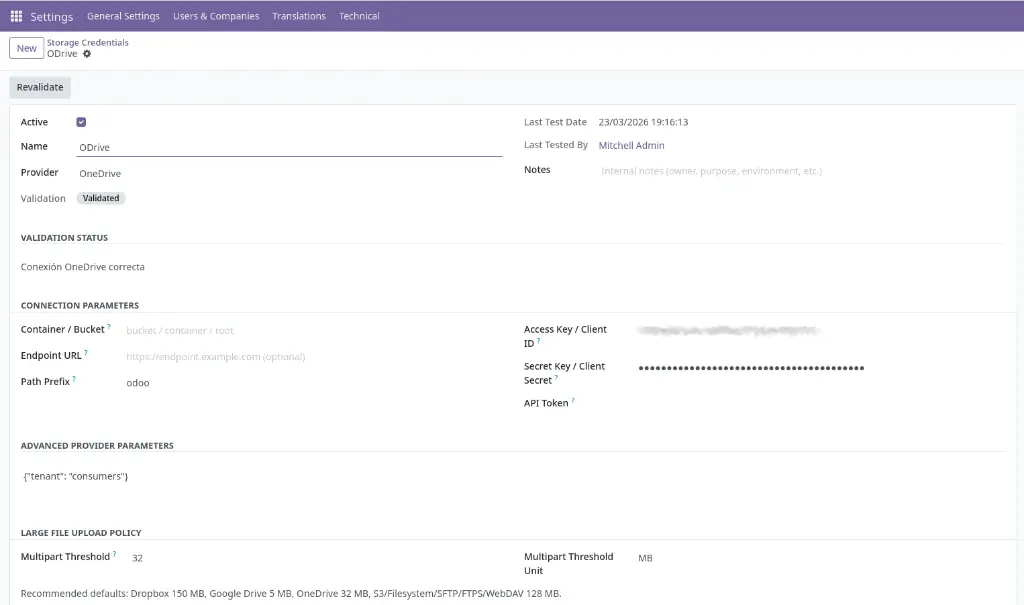
me/drive.tenant.{
"tenant": "common",
"timeout": 30
}
consumers instead of common.
How it is used
Operational notes
web.base.urlmust match your public HTTPS URL.- Behind a reverse proxy, enable
proxy_mode = Trueand pass the correct HTTPS scheme to Odoo. - If Microsoft does not return a refresh token, re-consent may be required.
- If authorization fails with an audience or tenant mismatch, review the supported account types in Microsoft Entra and the configured tenant in the credential.
- For long-running jobs, configure
limit_time_real_cron = 3600inodoo.conf.
Operational safety
Attachment Control - OneDrive
Add OneDrive as a storage backend for Attachment Control so routing, audit, move, storage archive and restore workflows can work with Microsoft OneDrive through OAuth-based credentials.
What this connector adds
- OneDrive provider in Storage Credentials: create credentials for Microsoft OneDrive through OAuth 2.0.
- Credential-based backend usage: the core module can use this provider in routing, move, storage archive and restore flows.
- Generic backend operations: read, write, delete, list and connection test through the common backend API.
- Provider isolation: Microsoft-specific OAuth and Graph API logic stays outside the core module.
No data is sent to the developer. Data is sent only to the Microsoft APIs explicitly configured by the user.
Compatibility
- On-premise: supported.
- Odoo.sh: supported if outbound HTTPS access to Microsoft login and Graph APIs is allowed.
- Odoo Online: not supported for this connector because custom module code and callback routing are outside normal Odoo Online constraints.
Requirements
- Install the core module Attachment Control.
- Ensure the Python dependency
requestsis available in the same Python environment used by Odoo. - Install this connector module
attachment_storage_manager_onedrive. - Configure Microsoft application registration and the exact callback URL used by Odoo.
Microsoft OAuth setup
https://your-odoo.example.com/attachment_storage_manager_onedrive/oauth/callbackcommon to consumers automatically during authorization.web.base.url of Odoo exactly, including scheme and domain.
Credential fields
me/drive.tenant.{
"tenant": "common",
"timeout": 30
}
consumers instead of common.
How it is used
Operational notes
web.base.urlmust match your public HTTPS URL.- Behind a reverse proxy, enable
proxy_mode = Trueand pass the correct HTTPS scheme to Odoo. - If Microsoft does not return a refresh token, re-consent may be required.
- If authorization fails with an audience or tenant mismatch, review the supported account types in Microsoft Entra and the configured tenant in the credential.
- For long-running jobs, configure
limit_time_real_cron = 3600inodoo.conf.
Operational safety
Attachment Control - OneDrive
Añade OneDrive como backend de almacenamiento para Attachment Control para que los flujos de routing, audit, move, storage archive y restore puedan trabajar con Microsoft OneDrive mediante credenciales basadas en OAuth.
Qué añade este conector
- Proveedor OneDrive en Storage Credentials: crea credenciales para Microsoft OneDrive mediante OAuth 2.0.
- Uso de backend basado en credenciales: el módulo core puede usar este proveedor en los flujos de routing, move, storage archive y restore.
- Operaciones backend genéricas: lectura, escritura, borrado, listado y prueba de conexión mediante la API backend común.
- Aislamiento del proveedor: la lógica específica de Microsoft OAuth y Graph API permanece fuera del módulo core.
No se envía ningún dato al desarrollador. Los datos se envían únicamente a las APIs de Microsoft configuradas explícitamente por el usuario.
Compatibilidad
- On-premise: soportado.
- Odoo.sh: soportado si el acceso HTTPS saliente a Microsoft login y Graph APIs está permitido.
- Odoo Online: no soportado para este conector porque el código del módulo personalizado y el callback quedan fuera de las restricciones normales de Odoo Online.
Requisitos
- Instala el módulo core Attachment Control.
- Asegúrate de que la dependencia Python
requestsestá disponible en el mismo entorno Python usado por Odoo. - Instala este módulo conector
attachment_storage_manager_onedrive. - Configura el registro de aplicación de Microsoft y la URL exacta de callback usada por Odoo.
Configuración de Microsoft OAuth
https://your-odoo.example.com/attachment_storage_manager_onedrive/oauth/callbackcommon a consumers durante la autorización.web.base.url efectivo de Odoo, incluyendo esquema y dominio.
Campos de la credencial
me/drive.tenant fijo.{
"tenant": "common",
"timeout": 30
}
consumers en lugar de common.
Cómo se utiliza
Notas operativas
web.base.urldebe coincidir con tu URL pública HTTPS.- Detrás de un proxy inverso, activa
proxy_mode = Truey pasa correctamente el esquema HTTPS a Odoo. - Si Microsoft no devuelve un refresh token, puede ser necesario volver a conceder consentimiento.
- Si la autorización falla por un problema de audiencia o tenant, revisa los tipos de cuenta soportados en Microsoft Entra y el tenant configurado en la credencial.
- Para jobs de larga duración, configura
limit_time_real_cron = 3600enodoo.conf.
Seguridad operativa
Attachment Control - OneDrive
Añade OneDrive como backend de almacenamiento para Attachment Control para que los flujos de routing, audit, move, storage archive y restore puedan trabajar con Microsoft OneDrive mediante credenciales basadas en OAuth.
Qué añade este conector
- Proveedor OneDrive en Storage Credentials: crea credenciales para Microsoft OneDrive mediante OAuth 2.0.
- Uso de backend basado en credenciales: el módulo core puede usar este proveedor en los flujos de routing, move, storage archive y restore.
- Operaciones backend genéricas: lectura, escritura, borrado, listado y prueba de conexión mediante la API backend común.
- Aislamiento del proveedor: la lógica específica de Microsoft OAuth y Graph API permanece fuera del módulo core.
No se envía ningún dato al desarrollador. Los datos se envían únicamente a las APIs de Microsoft configuradas explícitamente por el usuario.
Compatibilidad
- On-premise: soportado.
- Odoo.sh: soportado si el acceso HTTPS saliente a Microsoft login y Graph APIs está permitido.
- Odoo Online: no soportado para este conector porque el código del módulo personalizado y el callback quedan fuera de las restricciones normales de Odoo Online.
Requisitos
- Instala el módulo core Attachment Control.
- Asegúrate de que la dependencia Python
requestsestá disponible en el mismo entorno Python usado por Odoo. - Instala este módulo conector
attachment_storage_manager_onedrive. - Configura el registro de aplicación de Microsoft y la URL exacta de callback usada por Odoo.
Configuración de Microsoft OAuth
https://your-odoo.example.com/attachment_storage_manager_onedrive/oauth/callbackcommon a consumers durante la autorización.web.base.url efectivo de Odoo, incluyendo esquema y dominio.
Campos de la credencial
me/drive.tenant fijo.{
"tenant": "common",
"timeout": 30
}
consumers en lugar de common.
Cómo se utiliza
Notas operativas
web.base.urldebe coincidir con tu URL pública HTTPS.- Detrás de un proxy inverso, activa
proxy_mode = Truey pasa correctamente el esquema HTTPS a Odoo. - Si Microsoft no devuelve un refresh token, puede ser necesario volver a conceder consentimiento.
- Si la autorización falla por un problema de audiencia o tenant, revisa los tipos de cuenta soportados en Microsoft Entra y el tenant configurado en la credencial.
- Para jobs de larga duración, configura
limit_time_real_cron = 3600enodoo.conf.