- All Products
- All Products
- Attachment Control for Odoo - S3 Connector
Attachment Control for Odoo - S3 Connector
https://spre.es/shop/attachment-control-for-odoo-s3-connector-72 https://spre.es/web/image/product.template/72/image_1920?unique=cf5a0edAttachment Control - S3
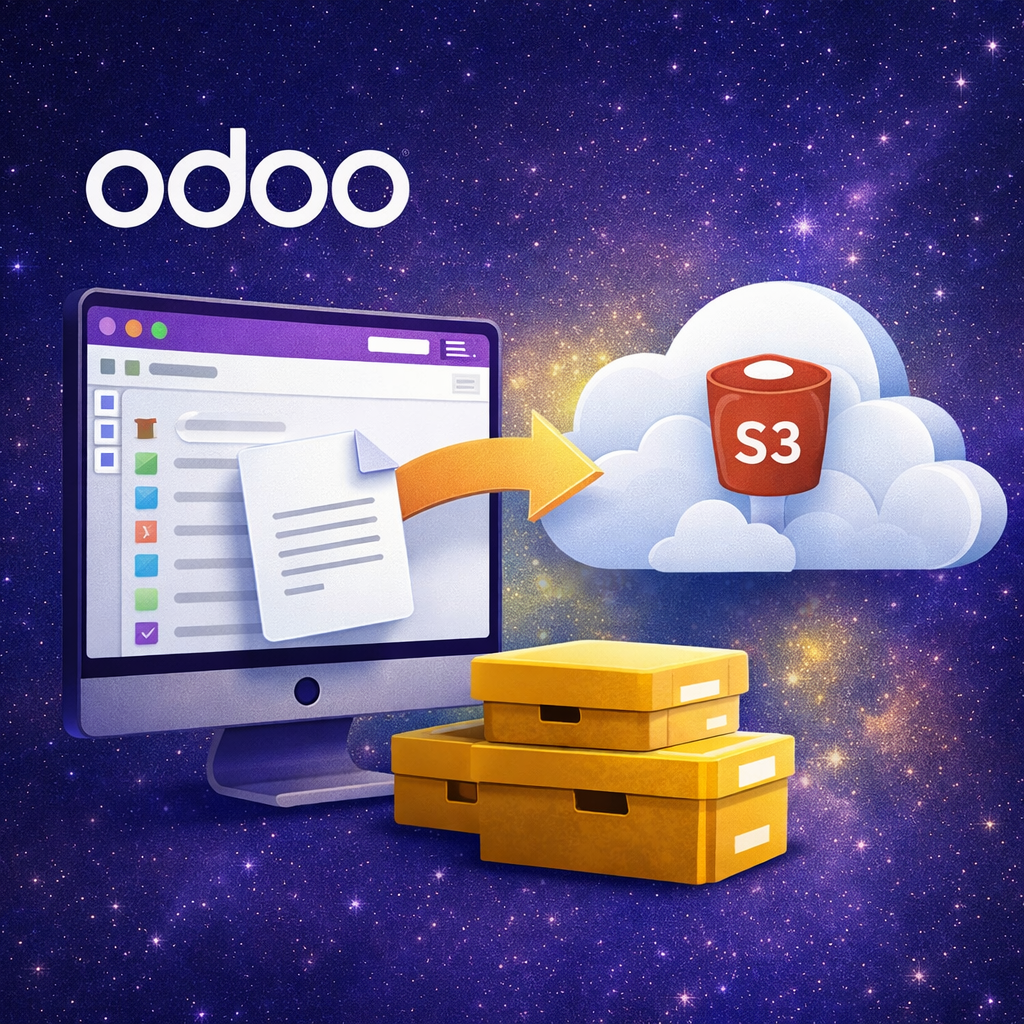
Add Amazon S3 and S3-compatible object storage to Attachment Control so routing, audit, move, storage archives and restore workflows can work with AWS S3, MinIO, Ceph, Wasabi and similar backends.
What this connector adds
- S3 provider in Storage Credentials: create credentials for AWS S3 or S3-compatible services.
- Credential-based backend usage: the core module can use this provider in routing, move, storage archive and restore flows.
- Generic backend operations: read, write, delete, list and connection test through the common backend API.
- Provider isolation: S3-specific dependencies stay outside the core module.
No data is sent to the developer. Data is sent only to the storage service explicitly configured by the user.
Compatibility
- On-premise: supported.
- Odoo.sh: supported if the Python dependency is available in the build/runtime.
- Odoo Online: not supported for this connector because custom Python dependencies are not available.
Requirements
- Install the core module Attachment Control.
- Install the Python dependency
boto3in the same Python environment used by Odoo. - Install this connector module
attachment_storage_manager_s3. - Restart Odoo.
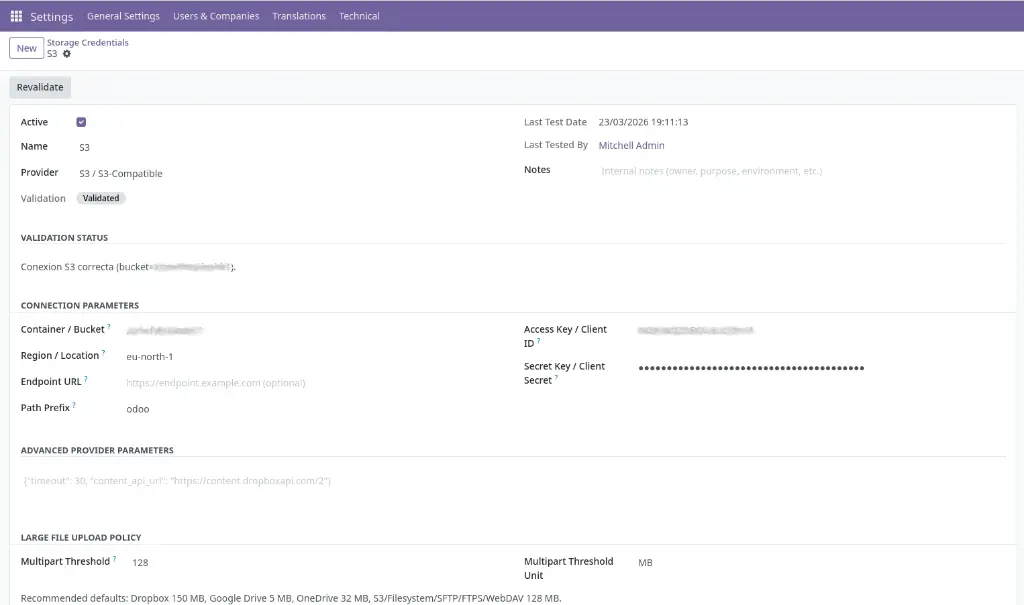
Credential fields
Examples
Example 1: AWS S3
- Provider: S3 / S3-Compatible
- Name: AWS S3 Production
- Container / Bucket:
my-company-attachments - Region / Location:
eu-west-1 - Endpoint URL: empty
- Path Prefix:
odoo/attachments - Access Key / Client ID:
AKIA... - Secret Key / Client Secret: your AWS secret access key
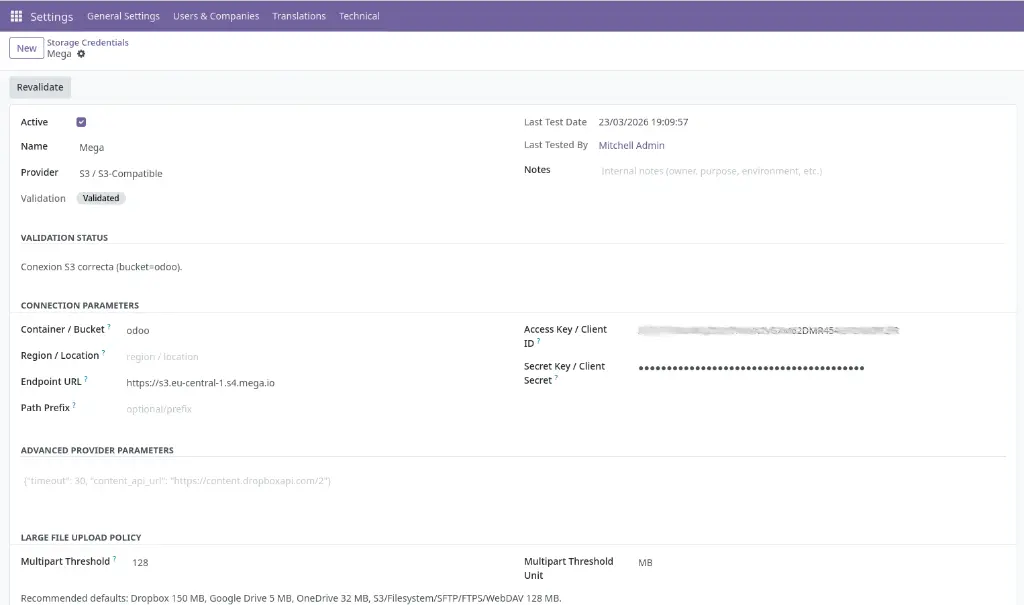
Example 2: S3-compatible
- Provider: S3 / S3-Compatible
- Name: MinIO Attachments
- Container / Bucket:
attachments - Region / Location: optional unless the provider requires it
- Endpoint URL:
https://minio.example.com - Path Prefix:
odoo17/attachments - Access Key / Client ID: provider access key
- Secret Key / Client Secret: provider secret key
How it is used
Operational notes
- The remote bucket must already exist before running test, move, storage or restore operations.
- Always test the credential before enabling production use.
- For long-running jobs, configure
limit_time_real_cron = 3600inodoo.conf. - Use least-privilege credentials and, in production, prefer a dedicated bucket or prefix.
Operational safety
Attachment Control - S3
Add Amazon S3 and S3-compatible object storage to Attachment Control so routing, audit, move, storage archives and restore workflows can work with AWS S3, MinIO, Ceph, Wasabi and similar backends.
What this connector adds
- S3 provider in Storage Credentials: create credentials for AWS S3 or S3-compatible services.
- Credential-based backend usage: the core module can use this provider in routing, move, storage archive and restore flows.
- Generic backend operations: read, write, delete, list and connection test through the common backend API.
- Provider isolation: S3-specific dependencies stay outside the core module.
No data is sent to the developer. Data is sent only to the storage service explicitly configured by the user.
Compatibility
- On-premise: supported.
- Odoo.sh: supported if the Python dependency is available in the build/runtime.
- Odoo Online: not supported for this connector because custom Python dependencies are not available.
Requirements
- Install the core module Attachment Control.
- Install the Python dependency
boto3in the same Python environment used by Odoo. - Install this connector module
attachment_storage_manager_s3. - Restart Odoo.
Credential fields
Examples
Example 1: AWS S3
- Provider: S3 / S3-Compatible
- Name: AWS S3 Production
- Container / Bucket:
my-company-attachments - Region / Location:
eu-west-1 - Endpoint URL: empty
- Path Prefix:
odoo/attachments - Access Key / Client ID:
AKIA... - Secret Key / Client Secret: your AWS secret access key
Example 2: S3-compatible
- Provider: S3 / S3-Compatible
- Name: MinIO Attachments
- Container / Bucket:
attachments - Region / Location: optional unless the provider requires it
- Endpoint URL:
https://minio.example.com - Path Prefix:
odoo17/attachments - Access Key / Client ID: provider access key
- Secret Key / Client Secret: provider secret key
How it is used
Operational notes
- The remote bucket must already exist before running test, move, storage or restore operations.
- Always test the credential before enabling production use.
- For long-running jobs, configure
limit_time_real_cron = 3600inodoo.conf. - Use least-privilege credentials and, in production, prefer a dedicated bucket or prefix.
Operational safety
Attachment Control - S3
Añade Amazon S3 y almacenamiento de objetos compatible con S3 a Attachment Control para que los flujos de routing, audit, move, storage archives y restore puedan trabajar con AWS S3, MinIO, Ceph, Wasabi y backends similares.
boto3 está disponible | On Premise: soportadoQué añade este conector
- Proveedor S3 en Storage Credentials: crea credenciales para AWS S3 o servicios compatibles con S3.
- Uso de backend basado en credenciales: el módulo core puede usar este proveedor en los flujos de routing, move, storage archive y restore.
- Operaciones backend genéricas: lectura, escritura, borrado, listado y prueba de conexión mediante la API backend común.
- Aislamiento del proveedor: las dependencias específicas de S3 permanecen fuera del módulo core.
No se envía ningún dato al desarrollador. Los datos se envían únicamente al servicio de almacenamiento configurado explícitamente por el usuario.
Compatibilidad
- On-premise: soportado.
- Odoo.sh: soportado si la dependencia Python está disponible en el build/runtime.
- Odoo Online: no soportado para este conector porque las dependencias Python personalizadas no están disponibles.
Requisitos
- Instala el módulo core Attachment Control.
- Instala la dependencia Python
boto3en el mismo entorno Python usado por Odoo. - Instala este módulo conector
attachment_storage_manager_s3. - Reinicia Odoo.
Campos de la credencial
Ejemplos
Ejemplo 1: AWS S3
- Provider: S3 / S3-Compatible
- Name: AWS S3 Production
- Container / Bucket:
my-company-attachments - Region / Location:
eu-west-1 - Endpoint URL: vacío
- Path Prefix:
odoo/attachments - Access Key / Client ID:
AKIA... - Secret Key / Client Secret: tu secret access key de AWS
Ejemplo 2: S3-compatible
- Provider: S3 / S3-Compatible
- Name: MinIO Attachments
- Container / Bucket:
attachments - Region / Location: opcional salvo que el proveedor la requiera
- Endpoint URL:
https://minio.example.com - Path Prefix:
odoo17/attachments - Access Key / Client ID: access key del proveedor
- Secret Key / Client Secret: secret key del proveedor
Cómo se utiliza
Notas operativas
- El bucket remoto debe existir previamente antes de ejecutar pruebas, moves, storage o restores.
- Prueba siempre la credencial antes de habilitar su uso en producción.
- Para jobs de larga duración, configura
limit_time_real_cron = 3600enodoo.conf. - Usa credenciales con mínimos privilegios y, en producción, prioriza un bucket o prefijo dedicado.
Seguridad operativa
Attachment Control - S3
Añade Amazon S3 y almacenamiento de objetos compatible con S3 a Attachment Control para que los flujos de routing, audit, move, storage archives y restore puedan trabajar con AWS S3, MinIO, Ceph, Wasabi y backends similares.
boto3 está disponible | On Premise: soportadoQué añade este conector
- Proveedor S3 en Storage Credentials: crea credenciales para AWS S3 o servicios compatibles con S3.
- Uso de backend basado en credenciales: el módulo core puede usar este proveedor en los flujos de routing, move, storage archive y restore.
- Operaciones backend genéricas: lectura, escritura, borrado, listado y prueba de conexión mediante la API backend común.
- Aislamiento del proveedor: las dependencias específicas de S3 permanecen fuera del módulo core.
No se envía ningún dato al desarrollador. Los datos se envían únicamente al servicio de almacenamiento configurado explícitamente por el usuario.
Compatibilidad
- On-premise: soportado.
- Odoo.sh: soportado si la dependencia Python está disponible en el build/runtime.
- Odoo Online: no soportado para este conector porque las dependencias Python personalizadas no están disponibles.
Requisitos
- Instala el módulo core Attachment Control.
- Instala la dependencia Python
boto3en el mismo entorno Python usado por Odoo. - Instala este módulo conector
attachment_storage_manager_s3. - Reinicia Odoo.
Campos de la credencial
Ejemplos
Ejemplo 1: AWS S3
- Provider: S3 / S3-Compatible
- Name: AWS S3 Production
- Container / Bucket:
my-company-attachments - Region / Location:
eu-west-1 - Endpoint URL: vacío
- Path Prefix:
odoo/attachments - Access Key / Client ID:
AKIA... - Secret Key / Client Secret: tu secret access key de AWS
Ejemplo 2: S3-compatible
- Provider: S3 / S3-Compatible
- Name: MinIO Attachments
- Container / Bucket:
attachments - Region / Location: opcional salvo que el proveedor la requiera
- Endpoint URL:
https://minio.example.com - Path Prefix:
odoo17/attachments - Access Key / Client ID: access key del proveedor
- Secret Key / Client Secret: secret key del proveedor
Cómo se utiliza
Notas operativas
- El bucket remoto debe existir previamente antes de ejecutar pruebas, moves, storage o restores.
- Prueba siempre la credencial antes de habilitar su uso en producción.
- Para jobs de larga duración, configura
limit_time_real_cron = 3600enodoo.conf. - Usa credenciales con mínimos privilegios y, en producción, prioriza un bucket o prefijo dedicado.